MY FLAG IS WHITE
I am an artist — not a criminal.
The country where I was born is committing an international crime.
I refuse to be complicit in the terror Russia is inflicting on Ukraine.
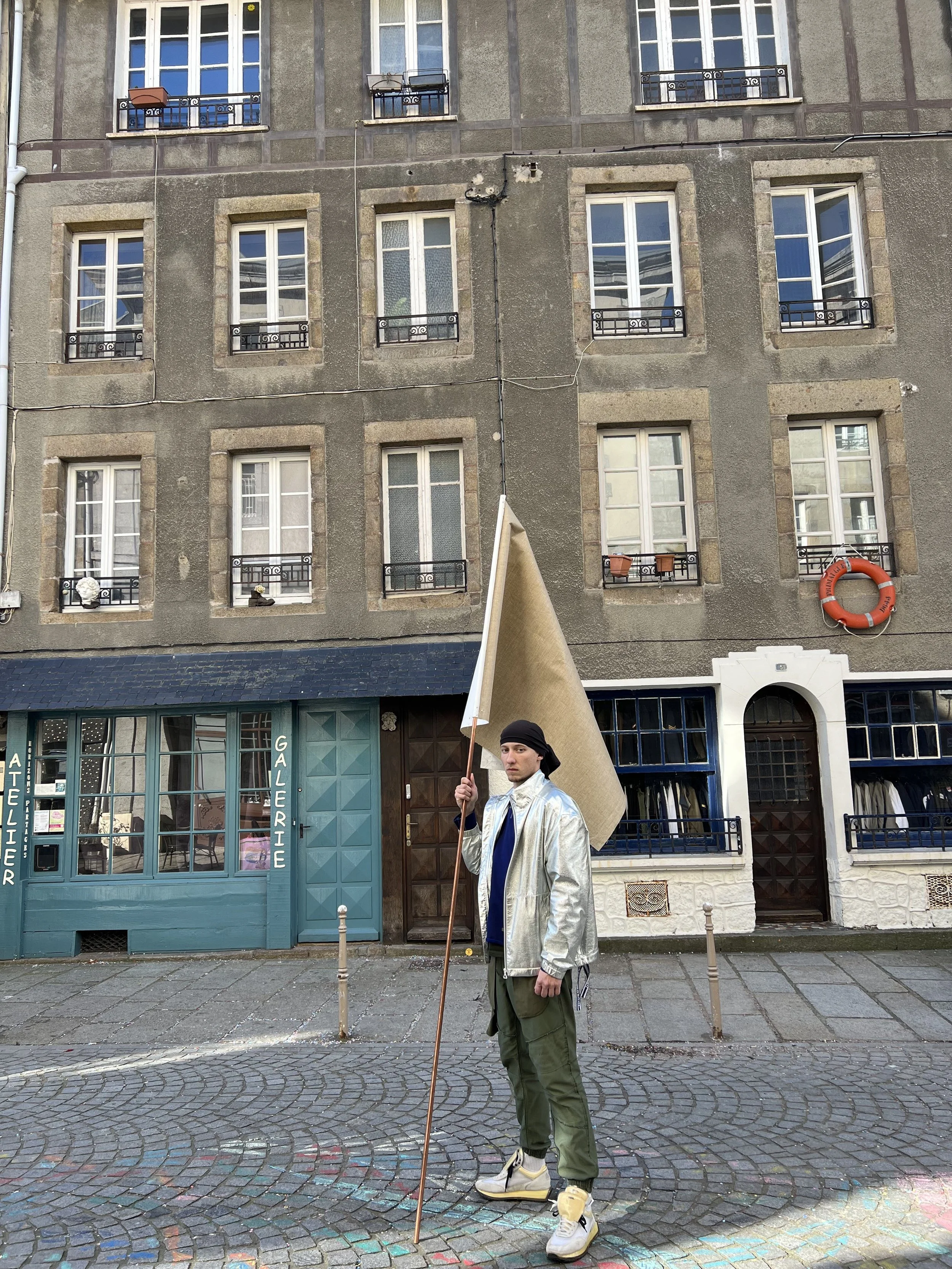
I raised my white canvas. The new flag of Russia — a symbol demanding the immediate end of Russian terror in this unjust war.
I believe every Russian citizen must do the same: resist and refuse to be dragged into this crime against humanity.
—Vlas Kuzma

ACT I
A standard-bearer without an army, Vlas Kuzma makes his own landing in Normandy. The place where liberation began becomes a stage for inner warfare. The shore once chosen for the first blow against fascism becomes a site of another confrontation — silent and personal.
He raises a white canvas on a pole, declaring it the New Russian Flag. This is a demarche of conscience, an act of resistance and self-exile — a step outside of identity, a refusal to remain a fragment of a war-driven regime.
"My art is simultaneously my standard, my painting, and my war-banner. My inner cry against the absence of humanity — a burial shroud for tyrants and their followers."
The gesture of raising a blank flag recalls the avant-garde’s dream of the tabula rasa — the empty surface as a promise of renewal. Yet here, the void is not utopian but ethical: a refusal to carry the war-tainted symbols of the Russian state.
This white is not blank. It is a New Flag held out to every Russian citizen — a call to stop this war before it erases all that is human.
.
WHITE FLAG

-
Medium: Performance art (live, durational); canvas as flag mounted on copper pole, public repetitive gesture
Post-performance intervention: Copper pole shortened as part of the transformation
Materials: Canvas, copper pipe, acrylic paint
Dimensions: Canvas: 105 × 125 cm (41 3/8 × 49 1/4 in.); copper pole: 300 cm (118 1/8 in.) during performance, transformed to 176 cm (69 1/2 in.)

Granville, Normandy, France
— February 24, 2023
A live performance created in response to one year of the full-scale war in Ukraine, presented at the Museum of Modern Art Richard Anacréon (MamRA) with the support of the City of Granville.
.
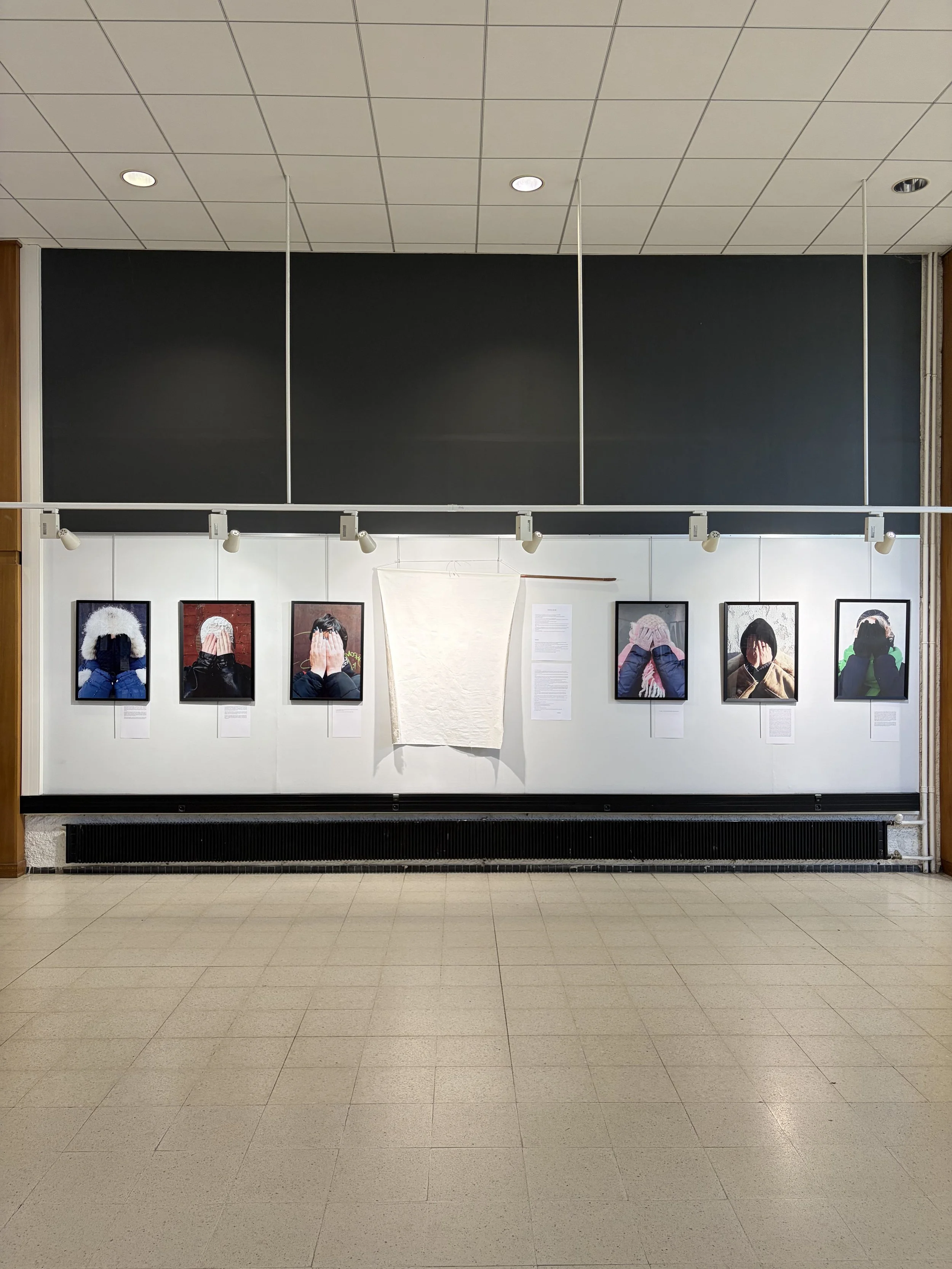
Rennes, Brittany, France
— March 18, 2026
White Flag as part of the exhibition "Portraits de l'époque de la dictature", a public performance and manifesto presented at Rennes 2 University.
.
MANIFESTO
You call me Russian?
I was born at the twilight of the USSR.
But it was not Russia — it was a vast prison.
Within that prison lived peoples of many nationalities: Ukrainians, Armenians, Azerbaijanis, Kazakhs, Lithuanians, Latvians, Estonians, and many others.
My ancestors were victims of repression without any particular reason,
like millions of others under Stalin’s regime.
From a young age, I stood for a European future
and the need to acknowledge the mistakes of history
to give my country a chance to change.
But year after year,
Russia built a myth through propaganda
designed to fuel its revanchist ambitions.
At seventeen, I refused conscription
in order to engage in volunteer and community work.
I did not want to swear allegiance
to a state that practices imperial chauvinism
and still conceals the truth
about Stalinist repressions.
At the military recruitment office,
I was offered a “great honor” —
to serve in the Kremlin Regiment
because of my height
and the light color of my eyes.
I refused on principle.
I could not swear allegiance
to a country that is incapable
of being honest with its own people.
After my refusal,
I was told they would “break my life.”
The doctor on the draft commission
immediately assigned me a psychiatric diagnosis
that restricted my rights.
Punitive psychiatry is a legacy of the USSR:
diagnoses are assigned
to those who displease the regime
in order to maintain total control over them
and to enable their confinement or torture
without officially acknowledging political persecution.
This is how the state marks you —
to keep you in fear.
Many dissidents, artists, intellectuals,
and political opponents
have passed through this system.
Despite my legal education,
all social mobility was closed to me.
I turned to artistic disciplines.
We wanted to change our country.
We took to the streets,
we protested,
we spoke in the media.
But Russia chose another path —
one of justifying its failures
through revanchism
directed against the West.
Over the years of Vladimir Putin’s rule,
propaganda fueled hatred,
and the regime became increasingly aggressive
toward those it considers enemies —
both inside the country
and beyond its borders.
The year 2022
and the full-scale invasion of Ukraine
divided my life —
like that of so many others —
into a before
and an after.
All my worst fears came true.
Everything I had opposed
while living in Russia
has become reality.
Strikes on Ukrainian cities.
Political purges.
Prison sentences
for a simple “like” on social media.
Millions of victims
after years of war.
Convictions
for speaking the word “peace.”
You call me Russian?
I no longer have a flag.
I cannot identify
with a flag
under which Ukrainian cities are bombed.
My flag
is white.
— Vlas Kuzma
ARCHIVE